

CPPCC members discuss consolidating and improving basic rural management system
Updated: 2025-12-10
en.cppcc.gov.cn
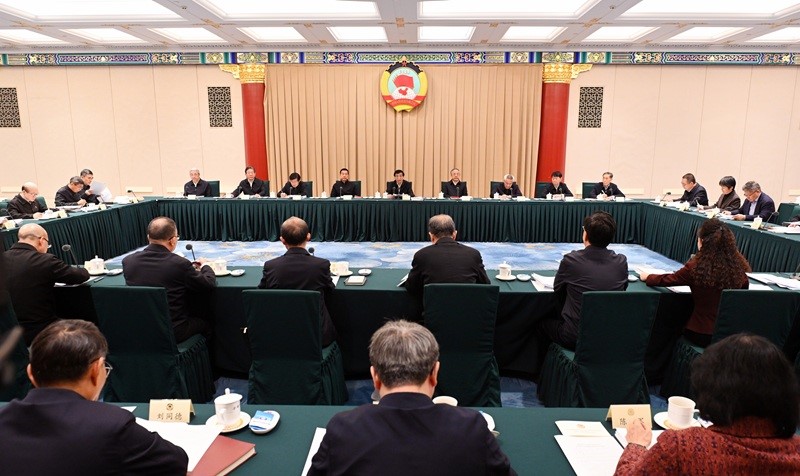
Wang Huning, a member of the Standing Committee of the Political Bureau of the Communist Party of China Central Committee and chairman of the Chinese People's Political Consultative Conference (CPPCC) National Committee, presides over the 40th biweekly consultation meeting of the 14th CPPCC National Committee in Beijing on Dec 9. [Photo by Jiang Guidong/CPPCC Daily]
The 14th National Committee of the Chinese People's Political Consultative Conference (CPPCC) held its 40th biweekly consultation meeting in Beijing on Dec 9. The meeting focused on consolidating and improving the basic rural management system.
Wang Huning, a member of the Standing Committee of the Political Bureau of the Communist Party of China (CPC) Central Committee and chairman of the CPPCC National Committee, presided over the meeting.
Wang noted that since the 18th CPC National Congress in 2012, the CPC Central Committee has attached great importance to consolidating and improving the basic rural management system. The CPC Central Committee has made a series of important decisions concerning stabilizing rural land contracting, deepening the reform of separating rural land ownership from contracted management rights, advancing the reform of the rural collective property rights system, fostering new types of agribusinesses, improving commercial agricultural services, and supporting appropriately scaled agricultural operations, he added.
These decisions are of great importance for laying solid foundations for powering comprehensive rural vitalization, as well as rural and agricultural modernization, he said.
Wang called for further study and implementation of the important decisions made by the CPC Central Committee concerning agriculture, farmers and rural areas.
He also urged more research-based consultation and policy recommendations, in order to contribute wisdom and strength to advancing rural and agricultural modernization.
Noting that the basic rural management system serves as the foundation for the Party's rural policies and rural vitalization, Wang called upon CPPCC members to focus on issues related to prudently promoting the reform of rural land system, deepening the reform of separating rural land ownership from contracted management rights at the same pace as the new-type urbanization, fostering new types of agribusinesses, building modern agricultural management system, pushing forward agricultural development driven by sci-tech advancements, and building convenient and efficient commercial agricultural services.
CPPCC members should report situations and make suggestions on these issues by conducting investigations and surveys, collecting public opinions, and submitting proposals, according to Wang.
Wang also urged CPPCC members to publicize the great accomplishments made in rural and agricultural reforms in the new era, strengthen theoretical research on rural land issues in contemporary China, and leverage their expertise to conduct "serving the people" activities.
CPPCC members should connect with and help farmers, sponsor education of their children, support people with disabilities and the vulnerable, and provide legal assistance, so as to bring tangible benefits to the people and build extensive consensus, Wang noted.
Ten members of the CPPCC National Committee and one expert shared their views at the meeting. They emphasized deepening reform of agriculture and rural areas and improving the policies and legal systems governing the basic rural management system.
They stressed strengthening reform of rural land contracting, improving the separation of land rights and advancing trials on extending rural land contracts by another 30 years upon the expiration of second-round contracts, in order to guarantee standardized and orderly circulation of land management rights.
They also called for establishing a convenient and efficient commercial agricultural service system, harmoniously aligning small farming households with modern agriculture, building a modern agricultural management system, deepening reform of the rural collective property rights system, and exploring a new development course suited to the collective rural economy.
CPPCC National Committee vice-chairpersons Hu Chunhua, Wang Yong, Shao Hong, Gao Yunlong, Mu Hong, Wang Dongfeng, Jiang Xinzhi and Wang Guangqian attended the meeting. Senior officials from the National Development and Reform Commission, the Ministry of Finance and the Ministry of Agriculture and Rural Affairs provided briefings and engaged in discussions with CPPCC members.
Copyright © The National Committee of the Chinese People's Political Consultative Conference.
All rights reserved. Presented by China Daily.
京ICP备08100501号-1